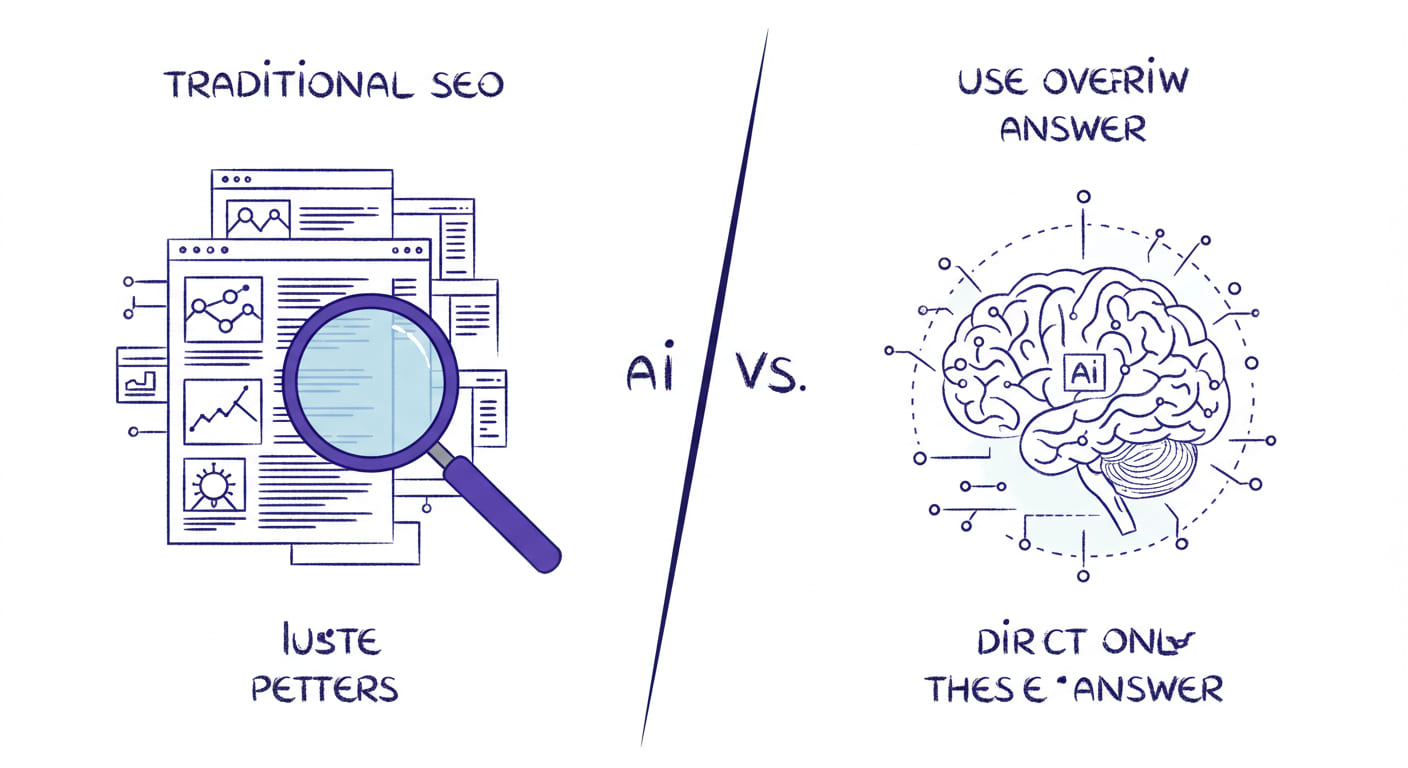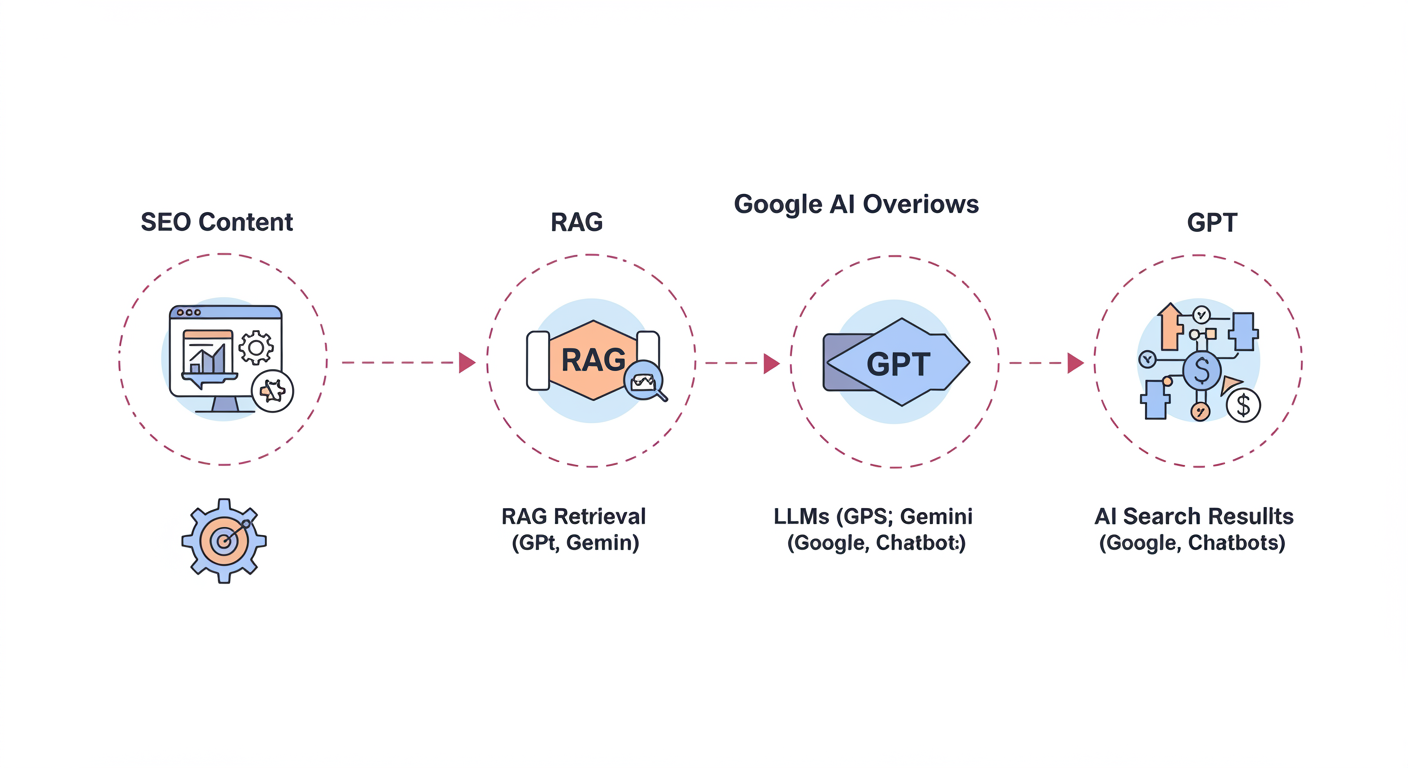

Want to rank on Google AI Overviews, get your content used by ChatGPT, or feature in Gemini's responses? The direct answer is to optimize your content for Retrieval-Augmented Generation (RAG). This means creating highly trustworthy, factual, well-structured, and comprehensive content that RAG systems can easily find, understand, and cite.
Traditional SEO focused on keywords and ranking in the "10 blue links." Today, search is rapidly transforming with the integration of Large Language Models (LLMs) like Google's Gemini, OpenAI's GPT, and Microsoft's Copilot. This shift is primarily driven by Retrieval-Augmented Generation (RAG).
What is RAG?
RAG is an AI framework that enhances LLMs by allowing them to retrieve factual, up-to-date information from external knowledge sources (like the web, databases, or specific documents) before generating a response. This combats common LLM limitations like hallucinations (making up facts) and outdated knowledge.
Why is RAG Critical for SEO Now?
- Google's AI Overviews (SGE): Google's new Search Generative Experience is powered by RAG. This means a significant portion of top-of-page search results are now AI-generated summaries, drawing directly from web content.
- LLMs as Information Hubs: Users increasingly ask questions directly to chatbots. For these chatbots to provide accurate answers, they need reliable, retrievable external data – your website's content.
- Future-Proofing: Optimizing for RAG is not just about current AI Overviews, but for the entire trajectory of AI-powered information retrieval.
Our Goal: To create content that RAG systems can easily discover, understand, trust, and utilize to answer user queries, thereby enhancing our visibility in AI-driven search experiences.
2. Foundational Pillars for RAG-Friendly Content
These principles ensure your content is a strong candidate for retrieval and synthesis by RAG systems.
2.1. E-E-A-T (Experience, Expertise, Authoritativeness, Trustworthiness)
Google's emphasis on E-E-A-T is amplified with RAG. AI systems need to trust the source of information.
Experience:
- Demonstrate First-Hand Knowledge: If reviewing a product, show you've used it. If providing a guide, demonstrate practical experience.
- Case Studies & Examples: Include real-world examples, screenshots, or testimonials that prove practical application.
Expertise:
- Author Credentials: Clearly display author bios with relevant qualifications, education, and professional experience.
- Specialization: Focus on topics where you or your organization genuinely have deep knowledge.
Authoritativeness:
- Industry Recognition: Are you cited by other reputable sites? Do industry experts reference your work?
- Backlinks: Earn high-quality, relevant backlinks from authoritative sources.
- Mentions & Citations: Encourage others to mention your brand or content.
Trustworthiness:
- Accuracy & Fact-Checking: Implement rigorous fact-checking processes. Cite reputable sources for all claims.
- Transparency: Clear contact information, privacy policies, and disclosure of affiliations.
- Security: Ensure your site is secure (HTTPS).
- User Reviews & Testimonials: Show social proof of trustworthiness.
2.2. Factual Accuracy & Verifiability
- Data-Driven Claims: Support all factual claims with current statistics, research studies, and expert quotes.
- External Citations: Link out to the original source of data, research papers, government reports, and reputable news outlets.
- Avoid Ambiguity: Present information clearly and unequivocally.
- Correcting Errors: Have a process for quickly identifying and correcting any inaccuracies.
2.3. Entity-Based Content & Semantic Understanding
- Comprehensive Topic Coverage: Fully explore a topic by discussing all relevant entities and their relationships.
- Example: Instead of just "best running shoes," cover "running shoe types," "brands," "materials," "foot strike patterns," "terrain types," "injury prevention," etc.
- Knowledge Graph Alignment: Understand how Google connects information. Structure your content to naturally fit into these relationships.
- Related Entity Inclusion: Naturally weave in related entities and sub-topics.
- Contextual Keyword Density: Focus on natural language. Use synonyms, related terms, and variations.
2.4. Clarity, Conciseness & Direct Answers
- Answer-First Approach: Provide the direct answer early in the content.
- Scannable Structure:
- Short Paragraphs
- Bullet Points & Numbered Lists
- Clear Headings & Subheadings
- Bold Text
- Simple Language: Write clearly and avoid jargon.
- Question-Answer Format: Include a dedicated FAQ section.
2.5. Structured Data (Schema Markup)
- Identify Relevant Schema Types:
HowTo,FAQPage,Article,Product,Review,LocalBusiness,Recipe,Event,VideoObject
- Accurate Implementation: Validate using Google's Rich Results Test.
- Consistency: Apply schema consistently across relevant content.
2.6. Comprehensiveness & Exhaustive Coverage
- Pillar Pages/Content Hubs: Create in-depth content that covers a broad topic.
- Topical Authority: Support pillars with clusters of specific, detailed articles.
- Anticipate Follow-Up Questions: Provide context and additional relevant details.
2.7. Freshness & Recency
- Regular Content Updates: Review and refresh evergreen content.
- Display Dates: Clearly show "last updated" information.
- Retire/Redirect Outdated Content: Avoid misleading RAG systems.
3. Implementation Strategies for RAG-Driven SEO
Content Audits:
- Identify Gaps
- Optimize Existing Content
- Consolidate/Expand thin or fragmented content
Content Briefs for New Content:
- Mandatory Sections: E-E-A-T, factual sources, target entities, structured data
- Outline Structure: Clear H1–H3 usage
- Target Audience & Intent
Technical SEO Foundation:
- Crawlability & Indexability
- Page Speed
- Mobile-Friendliness
- HTTPS Security
Internal Linking Strategy:
- Topical Authority: Contextual interlinking
- Pillar-to-Cluster Linking
- Descriptive Anchor Text
External Linking Strategy:
- Cite Your Sources
- Avoid "Link Farms"
Monitoring & Analytics:
- Google Search Console: Track AI Overviews and generative traffic
- Search Query Analysis
- Content Performance
- User Feedback
4. Leveraging AI Tools (Responsibly)
AI tools can assist, but human oversight is critical.
- Research & Ideation: Brainstorm related entities and questions
- Content Generation (Drafting): Human review required
- Schema Markup Generators
- Content Optimization Tools: Analyze for coverage and clarity
- Grammar & Plagiarism Checkers
5. Conclusion: The Future is RAG-Driven Quality
The evolution of search is a journey toward providing the most accurate, relevant, and comprehensive information. RAG is key to this transformation.
By focusing on high-quality, factual, well-structured, and authoritative content, you naturally align with RAG systems. This approach doesn't chase algorithms – it serves real users, which is the most effective long-term SEO strategy.